Automotive Digital Forensics: Expanding the Scope of Digital Evidence
Digital evidence is no longer confined to mobile devices and computers.
Digital evidence is no longer confined to mobile devices and computers. Advancements in 5G connectivity, cloud computing, and cybersecurity are enabling real time data exchange, predictive maintenance, and enhanced road safety, making automotive telematics a critical component of the future mobility ecosystem. Modern vehicles feature complex internal architectures and are wirelessly connected to the Internet, other vehicles, and smart city infrastructure. This connectivity introduces risks of cyber-attacks, criminal exploitation, and accident-related fraud, underscoring the growing need for automotive digital forensics.
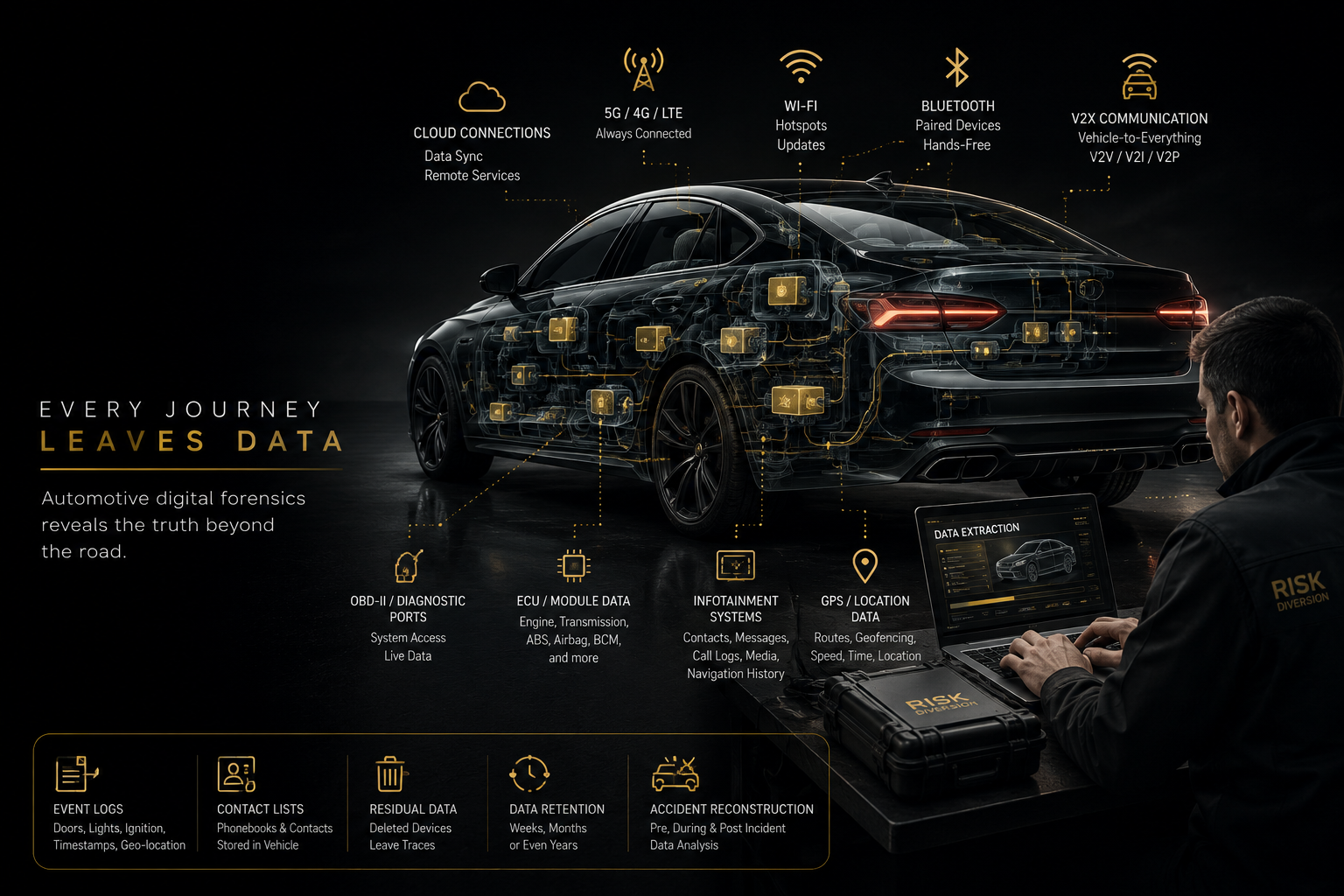
It is well established that increased system complexity amplifies vulnerabilities and potential attack vectors. Vehicles communicate extensively with the outside world through Vehicle to Everything (V2X) interfaces. Wireless connections include 3G/4G/5G, Wi-Fi, and Bluetooth, while physical connections occur via OBD-II, USB, and ECU diagnostic ports. The sheer volume of data generated within vehicles, combined with interactions with roadside units (RSUs) and cloud-based services, creates a vast forensic landscape.
Risk Diversion has identified a significant gap: the absence of standardized digital forensic guidelines and mechanisms within the automotive industry. Through numerous data extractions across different makes and models, we have observed that data is generated both internally (e.g., infotainment modules) and externally (e.g., cloud connections). However, the rapid pace of vehicle innovation, driven by competitive pressures, has often outpaced the implementation of robust security measures. The lack of standardization in data interfaces, recording units, and storage formats further complicates forensic investigations across brands and models.
Automotive forensics involves identifying, acquiring, and analyzing data that may serve as digital evidence. The relevance of specific data depends on the crime under investigation. Breaches of automotive systems, both wired and wireless have been widely reported in global media, highlighting critical safety concerns. Moreover, vehicles are frequently implicated in crimes, and nearly every incident today has a digital element. For example, simply connecting a smartphone to a car via USB for charging can result in phone data being stored on the infotainment system.
Common forensic artifacts include:
Event Logs: Records of doors opening/closing, lights switching on/off, often with timestamps and geolocation.
Contact Lists: Phonebooks uploaded and stored on infotainment systems.
Residual Device Data: Deleted devices often leave recoverable traces in unallocated space.
Connected Vehicle Data: Access to a suspect’s vehicle can provide evidence comparable to accessing their phone.
Data Retention: Information may persist for weeks, months, or even years.
Accident Reconstruction: Vehicle forensic data complements accident analysis, enabling detailed reconstructions of events before, during, and after incidents.
Risk Diversion has observed that prosecuting offenders increasingly involves extracting data from within vehicles. Systems designed to enhance the driving experience, such as infotainment and entertainment modules can provide critical evidence admissible in court.
The global automotive telematics market is experiencing rapid growth, driven by demand for connected vehicles, intelligent transportation systems, and advanced fleet management solutions. Automakers and mobility service providers are investing heavily in telematics platforms to improve performance, enhance customer experiences, and ensure regulatory compliance. Recognizing this trend, Risk Diversion has adapted its digital forensic capabilities to extract evidence from vehicles for use in criminal investigations and litigation.
Risk Diversion Blog